
by Nebula Haze
This bill was about re-opening the government, but changes to U.S. cannabis law were inserted before being signed into law. Here is the relevant part of the bill relating to hemp, cannabis, marijuana, and seed legality. Let me know if there’s something you believe should be on this page. I am not a lawyer or legal expert, but I try to stay informed.
3 Biggest Takeaways for a Home Grower
- Starts December 11, 2026 (no longer November 12, 2026) – H.R. 5371 was enacted on November 12, 2025, but the hemp and cannabis definition changes take effect a year later on
November 12, 2026now postponed to December 11, 2026. Learn more at NASC. - Seeds from high-THC plants are not hemp – The legal definition of hemp has now changed so that any viable seeds from a high-THC plant are excluded, even if the seeds themselves don’t contain THC.
- Most “intoxicating” hemp is not hemp – Hemp-derived products (including delta-8, delta-10, THC-A, and concentrated hemp flowers) are subject to new definitions and thresholds. In general, most types of hemp that can cause intoxication are now excluded from the new definition of hemp. The new hemp rules are now set to take effect December 11, 2026.
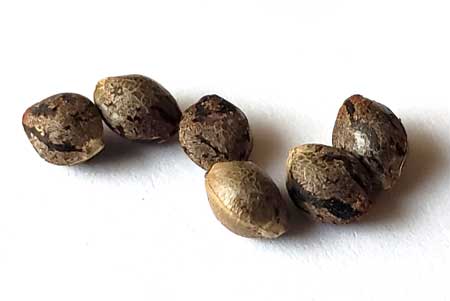
A closeup of cannabis seeds (where can I safely buy seeds?)
The following information was copied directly off the original bill.
U.S. Congress enacted H.R. 5371 on November 12, 2025, changing cannabis seed laws in the U.S. starting November 12, 2026 December 11, 2026.
.
Here is the related statutory text from the bill.
SEC. 781. Effective Date
7 U.S.C. § 1639o note
(a) Effective Date
Effective 365 days after the enactment of this Act, Section 297A of the Agricultural Marketing Act of 1946 (7 U.S.C. § 1639o) is amended as follows:
(1) Hemp
(A) In General
The term ‘hemp’ means the plant Cannabis sativa L. and any part of that plant, including the seeds thereof and all derivatives, extracts, cannabinoids, isomers, acids, salts, and salts of isomers, whether growing or not, with a total tetrahydrocannabinols concentration (including tetrahydrocannabinolic acid) of not more than 0.3 percent on a dry weight basis.
(B) Inclusion
Such term includes industrial hemp.
(C) Exclusions
Such term does not include—
- any viable seeds from a Cannabis sativa L. plant that exceeds a total tetrahydrocannabinols concentration (including tetrahydrocannabinolic acid) of 0.3 percent on a dry weight basis;
- any intermediate hemp-derived cannabinoid products containing—
- cannabinoids not capable of being naturally produced by a Cannabis sativa L. plant;
- cannabinoids that—
- are capable of being naturally produced by a Cannabis sativa L. plant; and
- were synthesized or manufactured outside the plant; or
- more than 0.3 percent combined total of—
- total tetrahydrocannabinols (including tetrahydrocannabinolic acid); and
- any other cannabinoids that have similar effects (or are marketed to have similar effects) on humans or animals as a tetrahydrocannabinol (as determined by the Secretary of Health and Human Services);
- any intermediate hemp-derived cannabinoid products which are marketed or sold as a final product or directly to an end consumer for personal or household use; or
- any final hemp-derived cannabinoid products containing—
- cannabinoids that are not capable of being naturally produced by a Cannabis sativa L. plant;
- cannabinoids that—
- are capable of being naturally produced by a Cannabis sativa L. plant; and
- were synthesized or manufactured outside the plant; or
- greater than 0.4 milligrams combined total per container of—
- total tetrahydrocannabinols (including tetrahydrocannabinolic acid); and
- any other cannabinoids that have similar effects (or are marketed to have similar effects) on humans or animals as a tetrahydrocannabinol (as determined by the Secretary of Health and Human Services).
(2) Industrial Hemp
The term ‘industrial hemp’ means hemp—
(A) grown for the use of the stalk of the plant, fiber produced from such a stalk, or any other non-cannabinoid derivative, mixture, preparation, or manufacture of such a stalk;
(B) grown for the use of the whole grain, oil, cake, nut, hull, or any other non-cannabinoid compound, derivative, mixture, preparation, or manufacture of the seeds of such plant;
(C) grown for purposes of producing microgreens or other edible hemp leaf products intended for human consumption that are derived from an immature hemp plant that is grown from seeds that do not exceed the threshold for total tetrahydrocannabinols concentration specified in paragraph (1)(C)(1);
(D) that is a plant that does not enter the stream of commerce and is intended to support hemp research at an institution of higher education (as defined in section 101 of the Higher Education Act of 1965 (20 U.S.C. 1001)) or an independent research institute; or
(E) grown for the use of a viable seed of the plant produced solely for the production or manufacture of any material described in subparagraphs (A) through (D).
(3) Hemp-Derived Cannabinoid Product
(A) In General
The term ‘hemp-derived cannabinoid product’ means any intermediate or final product derived from hemp (other than industrial hemp), that—
- contains cannabinoids in any form; and
- is intended for human or animal use through any means of application or administration, such as inhalation, ingestion, or topical application.
(B) Intermediate Hemp-Derived Cannabinoid Product
The term ‘intermediate hemp-derived cannabinoid product’ means a hemp-derived cannabinoid product which—
- is not yet in the final form or preparation marketed or intended to be used or consumed by a human or animal; or
- is a powder, liquid, tablet, oil, or other product form which is intended or marketed to be mixed, dissolved, formulated, or otherwise added to or prepared with or into any other substance prior to administration or consumption.
(C) Container
The term ‘container’ means the innermost wrapping, packaging, or vessel in direct contact with a final hemp-derived cannabinoid product in which the final hemp-derived cannabinoid product is enclosed for retail sale to consumers, such as a jar, bottle, bag, box, packet, can, carton, or cartridge.
(D) Exclusion from Container Definition
The term container excludes bulk shipping containers or outer wrappings that are not essential for the final retail delivery or sale to an end consumer for personal or household use.
(E) Exclusion
Such term does not include a drug that is the subject of an application approved under subsection (c) or (j) of section 505 of the Federal Food, Drug, and Cosmetic Act (21 U.S.C. 355).
Recommended action for home growers
- Don’t panic. Let’s wait and see how it plays out. There is a year before major legal changes come into effect.
- Stock up on good seeds – Can’t hurt to be extra safe. Make sure to store them so they last years and years. Try to get a variety of strains from different breeders to help increase overall genetic diversity. Store seeds in a cool, dry, dark space and they remain viable for years or even decades.
- US Voter? Cannabis is not inherently “left-wing” or “right-wing”. There are supporters and detractors on both sides. We need to stick together as growers to vote in pro-cannabis politicians, and vote out anti-cannabis politicians, regardless of party. Check the bottom of this page to learn what you can do.
Biggest Changes for a Cannabis Enthusiast
- Seeds are excluded from being “hemp” – There was a “loophole” from 2018 that made it so that cannabis seeds and young clones were technically considered a type of hemp, which is legal in the U.S.
- THC delta-8, THC delta-10, and THC-A are excluded from being “hemp” – These THC variants with similar effects used to be legal, but they are now specifically excluded from the new definition of hemp.
What to Realistically Expect
Will this law actually go into effect? I’m not a lawyer or legal expert. This is my personal opinion as someone who cares about the situation and tries to stay informed, but this is not legal advice.
- High Probability the Law Goes Into Effect – The law has been passed and signed already. Given the current political climate and current makeup of US Congress, it is unlikely this law gets overturned unless new politicians are voted in.
- 2026 Elections Matter – The only realistic chance of getting this law overturned is to elect pro-legalization politicians to Congress in the 2026 midterms (since Congress is the only legal body that can repeal this law). Will you be voting in the US mid-terms? Vote against any anti-cannabis activist. Specifically, all the states indicated in this map (regardless of color) have a Congress member up for election. These states need to vote against anti-cannabis Congressional candidates in the November 2026 mid-term election.
- If you can’t vote, or are not in one of those states, you can still help by determining which politicians, if any, in your local area or state, are supportive to weed. Simply knowing who to support and not support are key to change. Call pro-weed politicians and tell them they’re doing a good job. Call anti-weed politicians and tell them they’re losing your support. It’s shocking how often in politics the “squeaky wheel gets the grease”.
- Difficult to Enforce – Although seeds are losing legal status, the bill didn’t go so far as to allot funds to enforce these new laws. It remains to be seen whether the current government actually puts money to pursue the new legal definitions or not. On top of that, it’s difficult to enforce something like “seeds which come from high-THC plants” are banned while identical looking hemp seeds are legal, because you’d have to grow those seeds out to be sure. The FDA and DEA are in charge of enforcing these new laws, and may lack resources to police the market.
Short term effects
- Little short-term effect – The law is nearly a year away. That means your favorite seed companies aren’t going anywhere any time soon.
- Sales and discounts – Any breeder who’s thinking about changing their business model may want to offload seed stock. As a result, you may start seeing better deals and discounts, especially as it gets closer to the “go live” date.
Long-term effects (if law goes through)
- Fewer small breeders – When things get tougher in an industry, it often puts pressure on the smallest and most caring members. Big seed operators have access to lawyers, accountants, and payment processors, while small breeders and seed passion projects are at real risk. Similarly, you may see VC capital in the industry try to buy out their competition to gain a monopoly on the market.
- Seed companies go underground – There were seed banks long before there was any legalization, going back to at least the 80s and probably before. There will continue to be seed banks. However, they may find it more difficult to operate, which has a chilling effect on the industry and prevents growth and improvement.
- Fewer payment options – It becomes harder for seed companies to get payment processing whenever there’s any negative legalization coverage in the news. However, it is very unlikely options like Crypto (Etherium, Bitcoin) are going anywhere soon. They’re actually surprisingly easy to use and many seed vendors will give you discounts. Just be sure to only send Crypto to a trusted company as there’s no way to get it back.
- Intrastate-only shipping – Some cannabis seed operations will likely try to avoid crossing state lines. In other words, companies in legal states may start restricting sales outside the state, so they don’t have to ship over state lines.
To be safe, stock up on any seeds you really want.
Here’s how to store your seeds so they last forever.

